
Before You Launch the Change, Know Whether it Will be Adopted.
Most change initiatives fail in adoption, not design. This gives you a disciplined way to determine whether your organization is truly ready before you commit credibility and momentum.
The real risk is not the change. It is low readiness.
Most change initiatives do not fail because the strategy is wrong. They fail because readiness is assumed rather than tested.
- The same decisions revisited in slightly different language.
- Hesitation, rework, and half-implemented moves
- Public alignment. Private disagreement.
- Loss of initiative and narrowed problem solving
- Leaders pulled into firefighting instead of leading
You are not bleeding money. You are losing execution leverage.
Initiatives launch on time but stall in adoption.
Board confidence erodes as results lag.
Strategic windows close while alignment catches up.
Growth increases complexity. Complexity exposes misalignment.
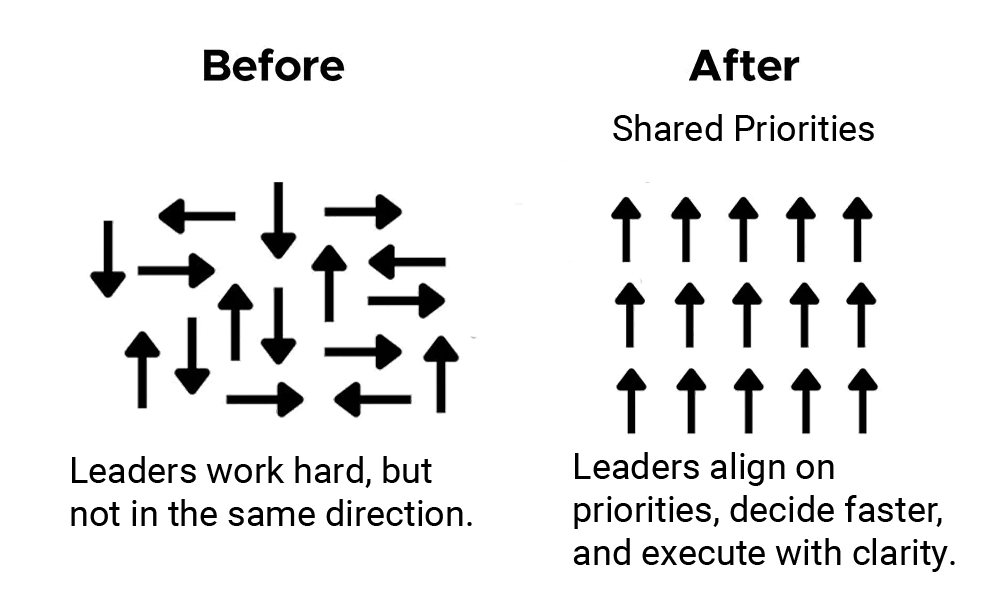
As organizations grow, clarity erodes faster than leaders realize. Roles blur. Decision rights shift. Signals get mixed. What worked at $20M does not scale to $200M. Without disciplined alignment, execution slows even when strategy improves.
A disciplined guide when the stakes are real

Leading meaningful change at the enterprise level is isolating.
You are expected to project confidence while carrying unanswered questions about alignment, adoption, and execution risk. The pressure to move quickly is real. So is the cost of getting it wrong. We understand that responsibility.
Brighton Leadership has spent more than two decades advising CEOs and senior leadership teams through growth, transition, reorganization, and strategic shifts. We work directly with leaders responsible for enterprise-level outcomes, not through delegated teams or layered consulting structures.
Our work is grounded in operating experience and implementation research, but translated into leadership decisions, not theory. We focus on clarity, alignment, and execution leverage, the factors that determine whether strategy becomes sustained behavior or stalls under pressure.
When adoption risk is unclear, experienced leaders do not guess. They get a disciplined read before committing the organization.
What change readiness gives you:
A predictive read on adoption risk
See whether commitment, confidence, and capacity are strong enough to support real behavior change.
Clarity before the organization commits
Surface misalignment and fragility early, before resistance hardens and credibility erodes.
Leadership Focus on the Few Behaviors That Determine Adoption
Identify which leadership behaviors and signals will accelerate adoption instead of adding noise.
A simple, disciplined path to clarity

Clarify the change and surface alignment
We begin with a focused executive conversation to clarify what is changing, why now, and what success requires. Leadership alignment, or misalignment, becomes visible before resistance hardens.

Replace assumptions with evidence
We measure real commitment, confidence, and leadership alignment so you can see where adoption will hold and where it will fracture under pressure.

Align, decide, and commit
The ambiguity ends. Your leadership team aligns around a shared reality and makes a disciplined call. Go forward, strengthen readiness, or adjust sequencing. You move ahead with clarity, ownership, and credibility intact.
Why readiness determines whether change sticks
Leaders often move quickly to planning and communication, assuming readiness will follow.
When readiness is low, people comply on the surface while resisting in practice. Uncertainty dominates attention. Leaders spend their time managing friction instead of enabling execution.
Readiness determines whether strategy becomes sustained behavior.
What do we leave with?
You leave with clarity that most leaders never get until it is too late.
Specifically, you will have:
- A clear, evidence based read on whether this change is likely to be adopted or quietly resisted
- Shared leadership alignment around the truth, not assumptions or optimism
- A decisive go, adjust, or not yet call, and confidence in that decision
- A focused readiness roadmap that shows exactly where leadership attention must go to increase adoption
- Clear ownership of next steps so execution does not drift
Most importantly, you leave knowing how to lead this change differently, not just how to communicate it again.
Instead of pushing harder and hoping for the best, you move forward with clarity, credibility, and control.

FAQ
Is this change management consulting?
No. Not in the traditional sense.
This is an executive level change readiness assessment and alignment process. Its purpose is not to manage the change for you, but to help you decide how and whether to move forward in a way that actually leads to adoption.
Traditional change management often focuses on plans, communications, and activities after a decision has already been made. We focus earlier, where success or failure is usually determined. We assess readiness because it is one of the strongest predictors of whether change will be adopted or quietly resisted, regardless of how good the plan looks on paper.
Our work draws on decades of leading real transformations and on research proven levers that shape commitment, confidence, and follow through. Whether you are implementing AI, shifting strategy, reorganizing, or changing systems and processes, readiness reduces risk by exposing what will accelerate execution and what will derail it.
This is not about adding work. It is about preventing avoidable failure and leadership drag before the organization pays the price.
Will this slow us down?
In practice, it almost always speeds execution up.
A short investment in readiness prevents the far more expensive slowdowns that come from misalignment, resistance, and rework once change is already underway. Leaders who skip readiness often move fast at the start, then spend months managing drag.
A readiness assessment helps you move faster because it:
- Reduces rework by clarifying what must change in the approach before execution begins
- Prevents false starts where initiatives launch on time but stall in adoption
- Surfaces misalignment early, when it is still easy to correct
- Focuses leadership effort on the few levers that actually accelerate adoption
- Preserves momentum by avoiding stop and restart cycles
- Keeps leaders out of firefighting mode so they can enable execution
This is the discipline of slowing down just enough to speed up what follows.
Instead of pushing harder against resistance later, you shape the conditions for adoption up front. The result is cleaner execution, fewer course corrections, and faster progress once the organization moves.
Readiness does not delay change. It prevents change from dragging on longer than it should.
What if we already have a change plan?
That is exactly when readiness matters most.
A solid plan answers what you intend to do. Readiness determines whether the organization can and will actually do it. Many change efforts fail not because the plan was wrong, but because the conditions for adoption were never strong enough to support it.
A readiness assessment complements your plan by answering different, critical questions:
- Do people believe this change is necessary and worth the effort
- Do they believe the organization can execute it successfully
- Are leaders aligned enough to send clear, consistent signals
- Where will adoption slow or break down once pressure hits
When those questions go unanswered, even strong plans turn into surface level compliance, repeated explanations, and execution drag.
Doing readiness work now allows you to:
- Adjust sequencing before momentum is lost
- Strengthen commitment and confidence where it matters most
- Focus leadership effort on the constraints that will limit execution
- Protect the credibility of the plan by increasing follow through
The plan tells you what to do. Readiness tells you whether it will work.
Addressing readiness before launch is not a detour. It is how experienced leaders increase the odds that a good plan actually delivers results.
Who needs to be involved?
At a minimum, the CEO and the executive team must be engaged. Readiness lives or dies with leadership alignment, so senior leaders cannot be delegated out of this work.
We also ask for one primary point of contact who can coordinate logistics, connect us to the right people, and keep momentum moving. This role ensures the process stays focused and efficient.
Depending on the scope of the change, we may involve a small number of additional leaders or influencers to get a truthful read on readiness. We are intentional about keeping this group as small as possible. The goal is insight, not participation theater.
We will also spend focused time with the executive sponsor of the change. Their clarity, ownership, and visible commitment are essential to shaping readiness and credibility across the organization.
This is a leadership level effort, designed to be light on time and heavy on insight.
Before you launch the change, get clarity.
Schedule a Change Readiness conversation to assess adoption risk, leadership alignment, and whether readiness is strong enough to support execution, or likely to stall it.